
One of the most persistent myths in personal finance is that investing — real investing, the kind that builds lasting wealth — is only accessible to people who already have a lot of money. That you need thousands of dollars before it’s even worth starting. That the world of dividend investing, with its promises of passive income and compounding growth, is a game for the wealthy.
That myth has never been less true than it is today.

Thanks to the elimination of trading commissions, the rise of fractional shares, the availability of low-cost exchange-traded funds, and mobile investing platforms that allow you to start with as little as $1, the barriers to entry for dividend investing have essentially collapsed. The mechanics that once required significant capital are now available to anyone with a smartphone and the discipline to set aside a modest amount of money each month.
What hasn’t changed is this: time is still the most powerful variable in the compounding equation. Every month you delay is a month of compounding you never get back. Starting small and starting now is vastly superior to waiting until you have “enough” — because in investing, there is no perfect amount to start with. There is only today, and there is tomorrow.
This guide will show you exactly how to begin dividend investing with limited capital: how to structure your approach, which accounts to use, what to buy, how to avoid the mistakes that sink beginners, and how to build a system that grows alongside your income over time.
First, Reframe What “Little Money” Means in This Context
Before we discuss mechanics, let’s address the psychology — because the way you think about your starting capital determines whether you take action or keep waiting.
“Little money” is relative. Someone earning $35,000 per year considers $500 significant. Someone earning $120,000 might not think twice about it. But in the context of dividend investing and long-term compounding, the absolute dollar amount of your first investment matters far less than you think. What matters is the habit, the consistency, and the time you allow the investment to work.
Consider this: $100 invested monthly into a dividend-growth portfolio earning an average total return of 8% per year — including reinvested dividends — grows to approximately $150,000 over 30 years. You contributed $36,000 of your own money. The market and compounding provided the rest. Now consider starting that same habit at $200 per month. The result after 30 years: approximately $300,000.
The math rewards consistency over lump sums, and time over amount. If you have $50, $100, or $500 to start — that is enough. The question is not how much you have. The question is whether you start.
Step 1: Build a Small Financial Foundation First
Dividend investing is a long-term wealth-building strategy. It is not designed to provide emergency liquidity. Before you invest a single dollar in dividend stocks, you need a basic financial foundation that protects your investments from being prematurely disrupted by life’s inevitable surprises.
Emergency Fund: Non-Negotiable
Before investing, ensure you have at least one to three months of essential expenses in a liquid, accessible savings account. This does not need to be the full six-month emergency fund often recommended — building that can come in parallel with beginning to invest. But you should have enough cash on hand that a car repair, medical bill, or temporary job disruption doesn’t force you to sell your investments at an inopportune time.
Selling dividend stocks prematurely — especially in a market downturn — can lock in losses, trigger tax consequences, and interrupt the compounding process. A basic cash buffer prevents that scenario.
High-Interest Debt: Address It Strategically
If you carry credit card debt at 20–25% interest, paying that down delivers a guaranteed, risk-free 20–25% return on every dollar applied to it. No dividend stock — not even the best — can reliably match that. Pay off high-interest consumer debt before or alongside beginning to invest.
Lower-interest debt — student loans at 4–5%, car loans, mortgages — is less urgent. Many investors comfortably carry these while building a dividend portfolio in parallel, since the expected long-term return of a quality dividend portfolio meaningfully exceeds these borrowing costs.
Know Your Monthly Surplus
Before you can invest consistently, you need to know exactly how much money is available for investment each month after essential expenses, debt payments, and a reasonable personal discretionary budget. Be honest. Overcommitting to investing and then pulling money back out creates friction, transaction costs, and bad habits. A sustainable, realistic monthly investment amount — even if it’s $50 — is worth far more than an ambitious amount you can’t maintain.
Step 2: Choose the Right Account Type
Where you hold your dividend investments is nearly as important as what you hold. Account type determines your tax treatment, your withdrawal flexibility, and your long-term after-tax returns. Getting this right from the beginning avoids costly mistakes later.
Tax-Advantaged Accounts: Start Here If Eligible
The most powerful accounts for long-term dividend investors are tax-advantaged retirement accounts. Inside these accounts, dividends are not taxed in the year received — they compound tax-deferred or tax-free, dramatically accelerating growth over time.
Roth IRA (Individual Retirement Account): The Roth IRA is arguably the single best account available to beginning investors with modest incomes. Contributions are made with after-tax dollars, but all growth — including dividend income — is completely tax-free. When you eventually withdraw in retirement, you pay zero taxes on decades of compounded growth. For dividend investors, this is extraordinarily valuable: dividends that would otherwise trigger annual tax events compound entirely unimpeded. Contribution limits apply (check current IRS limits for your tax year), and income eligibility phaseouts exist for higher earners, but most beginning investors qualify. If you can only use one account, make it a Roth IRA.
Traditional IRA: Contributions may be tax-deductible depending on your income and whether you have access to an employer plan. Growth is tax-deferred — you pay taxes upon withdrawal in retirement. Less ideal than a Roth for dividend investing because eventual withdrawals are taxed as ordinary income, but still dramatically better than a taxable account for compounding.
401(k) or 403(b) through Employer: If your employer offers a retirement plan with a match, contribute at least enough to capture the full match before directing money elsewhere. The employer match is an immediate, guaranteed 50–100% return on those dollars — no investment in the world beats that. Many employer plans offer dividend-focused ETF or mutual fund options. If investment choices are limited, maximize the match and contribute additional retirement savings to an IRA.
Taxable Brokerage Accounts: Flexible But Less Tax-Efficient
Once you’ve maximized your tax-advantaged contributions — or if you want access to your money before retirement age without penalties — a standard taxable brokerage account is your next tool. The advantages are flexibility: no contribution limits, no early withdrawal penalties, and the ability to invest in any security.
The disadvantage is tax drag. In a taxable account, qualified dividends are taxed in the year received at your long-term capital gains rate (0%, 15%, or 20% depending on income). Non-qualified dividends — including most REIT distributions — are taxed as ordinary income, which can be significantly higher. This annual tax event, compounded over decades, meaningfully reduces long-term after-tax returns compared to a tax-sheltered account.
The practical takeaway: fill your Roth IRA first (or at least simultaneously), use a taxable account for anything beyond those limits or when flexibility is needed, and focus on tax-efficient dividend payers in taxable accounts — qualified dividend stocks held for long periods rather than high-turnover funds or REIT-heavy portfolios.
Step 3: Select the Right Brokerage Platform
The brokerage you choose sets the conditions for everything that follows — fees, investment options, user experience, and the tools available to support your strategy. For beginning investors with limited capital, several factors matter most:
Zero Commission Trading
Commission-free trading is now the standard across major US brokerages. Fidelity, Charles Schwab, and Vanguard all offer $0 commissions on stock and ETF trades. There is no reason to pay per-trade commissions in 2026 — any brokerage still charging them is not worth using for an active investor.
Fractional Shares
Fractional shares are transformative for investors with limited capital. Rather than needing $180 to buy one full share of a stock trading at $180, fractional shares allow you to invest $10, $25, or $50 in a position — purchasing a proportional fraction of a share. You receive proportional dividends on your fractional holding.
This feature enables two things that were previously impossible for small investors: meaningful diversification across many companies regardless of their share price, and precise dollar-amount investing rather than being constrained by share price multiples. Fidelity and Charles Schwab both offer robust fractional share programs. Verify fractional share availability for the specific securities you intend to hold before selecting a platform.
Automatic Dividend Reinvestment (DRIP)
Every major brokerage offers automatic dividend reinvestment — the ability to have dividends automatically used to purchase additional shares (or fractional shares) of the same security without manual action. This is a foundational feature for beginning dividend investors. Enable it from day one and leave it on. The compounding effect of reinvested dividends over long periods is one of the most significant performance differentiators between dividend investors who build substantial wealth and those who don’t.
Automatic Recurring Investments
The ability to schedule automatic monthly investments — say, $100 into a dividend ETF on the first of each month, regardless of market conditions — removes the behavioral friction of manual investing and enables dollar-cost averaging without thought or effort. Fidelity, Schwab, and most other major platforms support this. It is among the most valuable features for disciplined long-term investors.
Account Minimums
Most major brokerages have eliminated account minimums entirely for standard brokerage and IRA accounts. You can open a Roth IRA at Fidelity with $1. There is no excuse related to minimum balances for not starting immediately.
Step 4: Understand What You’re Buying Before You Buy It
Many beginning investors make the mistake of buying individual dividend stocks before they have the knowledge to evaluate them properly. The result is often a portfolio built on yield chasing — buying the highest-yielding stocks without understanding whether those dividends are sustainable — which leads to dividend cuts, capital losses, and discouragement.
Before buying anything, understand these foundational concepts:
Dividend Yield Is Not the Same as Return
A stock with an 8% dividend yield does not automatically deliver an 8% return. If the stock price declines 10% over the year, your total return is negative even after collecting the dividend. Dividend yield is one component of total return — not a guarantee of it. Focus on companies with sustainable dividends, not just high current yields.
The Payout Ratio Tells You Whether the Dividend Is Safe
The payout ratio — dividends paid as a percentage of earnings or free cash flow — is the most basic indicator of dividend sustainability. A company paying out 40% of its earnings as dividends has significant cushion to maintain and grow payments. A company paying out 95% is operating with almost no margin of safety. Learn to check payout ratios before buying any individual dividend stock.
Dividend Growth Matters as Much as Current Yield
A 2.5% dividend growing at 10% per year will surpass a 5% dividend growing at 1% per year within about 8 years — and continue widening the gap indefinitely. For long-term investors with decades ahead of them, dividend growth rate is arguably more important than starting yield. Prioritize companies with consistent records of dividend increases over those offering the highest current income.
You Don’t Have to Pick Individual Stocks to Build a Dividend Portfolio
This is perhaps the most important thing a beginning investor with limited capital can understand: you do not need to select individual stocks to build a successful dividend portfolio. Dividend-focused ETFs provide instant, professional diversification across dozens or hundreds of dividend-paying companies for a single low annual fee. For investors starting out, ETFs are almost always the superior starting point.
Step 5: Start With Dividend ETFs — The Smart Entry Point
For investors with limited capital and limited experience, dividend ETFs are not a compromise — they are the optimal starting strategy. Here’s why:
Instant diversification: A single ETF holding might own 100–400 dividend-paying companies across multiple sectors. This level of diversification would be impossible to replicate with individual stocks at a small portfolio size without massive transaction complexity.
Built-in quality filtering: Most reputable dividend ETFs screen their holdings based on dividend quality criteria — yield sustainability, payout ratio, dividend growth history — so the fund itself is doing basic due diligence on your behalf.
Low cost: Quality dividend ETFs charge annual expense ratios of 0.05%–0.35%. On a $1,000 portfolio, that’s $0.50–$3.50 per year in fees. The cost of diversification is essentially zero.
Zero research burden for getting started: You don’t need to read annual reports, analyze balance sheets, or evaluate competitive moats to invest in a quality dividend ETF. You simply invest regularly, reinvest dividends, and let the fund managers handle the underlying analysis and rebalancing.
Which Dividend ETFs to Consider for Beginners
The ETF universe is vast, and not all dividend ETFs are created equal. Here are categories and well-known examples worth researching for your own situation:
Dividend Growth ETFs: These focus on companies with established records of consistently growing dividends, rather than maximizing current yield. They tend to hold higher-quality companies with lower payout ratios and stronger balance sheets. The tradeoff is that current yield is lower (typically 1.5%–3%), but total return and dividend growth potential are stronger. ETFs in this category have historically delivered excellent risk-adjusted total returns. Examples to research include funds tracking dividend growth indices from major providers like Vanguard, iShares, and Schwab.
High Dividend Yield ETFs: These prioritize current income by selecting stocks with above-average dividend yields. Current yield is typically 3%–4.5%, providing more income today. The tradeoff is that higher-yielding stocks sometimes carry more financial stress, and total return may lag dividend growth focused alternatives over long periods. Appropriate for investors who need income sooner or want to maximize current cash flow. Major providers offer multiple options in this category.
Dividend Aristocrats / Quality ETFs: Funds tracking indexes of companies with 25+ consecutive years of dividend increases focus on the most proven dividend growers in the market. Holdings tend to be large, established, financially conservative companies with dominant competitive positions. These funds combine quality and income with lower volatility characteristics.
International Dividend ETFs: Adding some international dividend exposure provides geographic diversification and access to dividend cultures in markets like Europe and Asia-Pacific where payout ratios are often higher than in the US. Be aware of foreign withholding taxes on dividends paid by international holdings.
When researching specific ETFs, compare: expense ratio (lower is better), number of holdings (more means more diversification), sector concentration (avoid funds with more than 30% in any single sector), historical dividend growth rate, and total return track record across full market cycles including downturns.
Step 6: Dollar-Cost Averaging — The Strategy That Removes Market Timing
Once you’ve selected your account, your brokerage, and your initial investment vehicles, the most important strategic decision is how to invest over time. For investors with limited capital who are building their portfolio gradually, dollar-cost averaging (DCA) is the answer.
Dollar-cost averaging means investing a fixed dollar amount at regular intervals — monthly, bi-weekly, or with each paycheck — regardless of what the market is doing. You don’t try to time the market. You don’t wait for dips. You simply invest on schedule, every time.
Why Dollar-Cost Averaging Works So Well for Beginning Investors
When prices are high, your fixed dollar amount buys fewer shares. When prices fall, the same dollar amount buys more shares at lower prices. Over time, this mechanical process results in an average cost per share that is lower than the average price over the same period — a mathematical advantage that works automatically without any skill or judgment required.
The behavioral advantage is equally important. Dollar-cost averaging removes the paralysis of trying to time the market. Beginning investors often wait for the “right moment” to invest — and that moment never feels perfectly right, so they delay indefinitely. DCA eliminates that decision entirely. The calendar makes the decision.
Set up automatic monthly contributions in your brokerage account. Even $50 or $100 per month, invested consistently over decades, produces meaningful wealth through compounding. Automate it so it happens without conscious effort, just like a utility bill — and gradually increase the contribution amount as your income grows.
Step 7: Reinvest Every Dividend — Without Exception
During your accumulation phase — the years before you need income from your portfolio — reinvesting every dividend you receive is the single most impactful habit you can build. This is not optional advice. It is the mathematical engine of long-term dividend wealth.
Here is why it matters so profoundly: when you reinvest dividends, you buy additional shares. Those additional shares pay dividends themselves. Those dividends buy more shares. Which pay more dividends. The cycle compounds continuously, and the effect accelerates dramatically over time because the base of dividend-generating shares grows constantly even without adding new capital.
Historically, a substantial portion of the total long-term return of dividend-paying stocks comes from this reinvestment compounding — not from price appreciation alone. Investors who take dividends as cash during their accumulation years and spend them are giving up one of the most powerful return-generation mechanisms available to them.
Enable automatic dividend reinvestment (DRIP) in your brokerage account from the moment you open it. Most brokerages offer this at no charge, and fractional share reinvestment means even small dividend payments are fully deployed rather than sitting as uninvested cash.
Only switch to taking dividends as cash income when you genuinely need the income to fund living expenses — typically at or near retirement. Until then, reinvest everything.
Step 8: Increase Your Investment Amount Over Time
Starting small is not the goal — it is the starting point. The most important commitment you can make alongside opening your account and making your first investment is to a specific plan for increasing your monthly contribution over time.
Here are practical approaches to growing your investment rate:
The Raise Rule: Every time you receive a salary increase, commit to directing at least half of the after-tax increase toward your investment account. If you earn $200 more per month after taxes, add $100 to your monthly investment contribution. You maintain a lifestyle improvement while accelerating your portfolio growth.
Annual Step-Ups: Set a calendar reminder every January to increase your monthly investment amount by a specific dollar amount — say, $25 or $50. It’s a small change that compounds significantly over years. Going from $100 to $125 per month doesn’t feel dramatic in any given month, but the long-term portfolio impact is substantial.
Windfall Allocation: Tax refunds, work bonuses, gifts, freelance income — any unexpected money represents an opportunity for a meaningful lump-sum addition to your portfolio. Resist the temptation to spend windfalls entirely on lifestyle expenses. Splitting them — half to investment, half to personal enjoyment — accelerates portfolio growth while still rewarding yourself.
Expense Reduction Redirects: When you pay off a debt — a car loan, a credit card — redirect that monthly payment amount directly to your investment account. You were already living without that money. It costs you nothing in lifestyle terms to redirect it, and it can add hundreds of dollars per month to your investment rate.
Step 9: Adding Individual Stocks — When and How
Starting with ETFs doesn’t mean you must stay exclusively in ETFs forever. As your portfolio grows and your knowledge deepens, adding individual dividend stocks alongside your ETF core can enhance income, provide focus on specific high-quality companies, and create a more personalized portfolio.
Here is a practical framework for when and how to add individual stocks:

When You’re Ready to Add Individual Stocks
Consider adding individual dividend stocks when your total portfolio has reached at least $5,000–$10,000, you have spent at least six to twelve months learning to read financial statements and evaluate dividend sustainability metrics, you can clearly articulate why a specific company represents a better opportunity than simply adding to your existing ETF positions, and you have the time and interest for ongoing monitoring of individual company fundamentals.
If any of these conditions aren’t met, there is no shame in staying entirely in ETFs indefinitely. Many excellent long-term investors never move beyond high-quality ETFs — and their results are often superior to those of investors who pick individual stocks poorly.
Building Individual Positions With Limited Capital
Fractional shares make building individual stock positions genuinely accessible. Rather than needing $500 to build a meaningful position in a stock trading at $250 per share, you can start with $25–$50 per position using fractional shares and add systematically over time.
A practical approach: once you decide to add individual stocks, allocate 70–80% of new monthly contributions to your ETF core and 20–30% to building individual stock positions. This keeps your foundation intact while allowing you to deliberately develop individual positions over time without taking on excessive concentration risk.
Sectors and Characteristics to Prioritize
For beginning investors adding their first individual dividend stocks, focus on the most predictable, time-tested sectors: consumer staples, healthcare, and utilities. These sectors have produced some of the longest dividend growth streaks in market history, tend to have more straightforward business models, and demonstrate more earnings resilience during economic downturns than cyclical or speculative sectors.
Within those sectors, look for the characteristics discussed throughout this guide: conservative payout ratios, strong free cash flow, manageable debt, durable competitive advantages, and a track record of dividend increases spanning at least a decade. These filters alone will significantly increase the quality of your individual stock selections.
Step 10: Track Progress and Stay the Course
One of the most important — and most underrated — habits of successful long-term dividend investors is tracking progress in a way that reinforces the right behaviors and metrics.
Track Annual Dividend Income, Not Just Portfolio Value
Portfolio value fluctuates with market conditions. In a given year, your portfolio might be worth $2,000 less than last year even though you invested diligently all year — because market prices declined. This can be discouraging and counterproductive if portfolio value is your primary scorecard.
Instead, track your annual dividend income — the total dividends your portfolio is projected to generate in the next twelve months. This number increases predictably every time you invest more, receive a dividend raise, or reinvest dividends into additional shares. It almost never decreases unless you sell holdings or a company cuts its dividend. Watching your annual dividend income grow from $50 to $200 to $500 to $1,200 — regardless of short-term price fluctuations — is the progress metric that actually reflects how your income-generating machine is performing.
Review Annually, Not Daily
Daily portfolio monitoring is one of the most destructive habits an investor can develop. It creates emotional reactions to short-term noise, tempts unnecessary trading, and generates anxiety that serves no useful purpose. For a dividend-focused investor, daily price movements are simply irrelevant to your strategy.
Instead, conduct a meaningful portfolio review once per year. Assess each holding’s dividend sustainability, check whether any payout ratios have deteriorated, evaluate whether contribution rates are on track, and consider whether your overall allocation still reflects your goals and risk tolerance. Eleven months of deliberate non-attention, followed by one month of focused review, is a better operating rhythm than daily anxiety.
Celebrate Milestones Along the Way
The compounding journey is slow at first and feels invisible. Make it tangible by celebrating specific milestones: your first $100 in annual dividend income, your first $500, your first $1,000. The first time your monthly dividend income covers a recurring bill — your phone, your streaming subscriptions, your groceries. These milestones make the abstract real and reinforce the behaviors that create long-term success.
Common Mistakes Beginners Make — and How to Avoid Them
Waiting Until They Have “Enough” to Start
The single most common and most costly mistake. Every month spent waiting is a month of compounding lost permanently. Start with whatever you have — even $25 or $50. The habit of investing and the time in the market matter infinitely more than the initial amount.
Choosing Stocks Based on Yield Alone
Buying any stock primarily because its yield is high — without understanding why the yield is high or whether the dividend is sustainable — is one of the fastest paths to dividend investing losses. High yields often signal financial distress, not generous income. Always investigate sustainability before yield.
Taking Dividends as Cash During the Accumulation Phase
Spending dividends rather than reinvesting them during the years before you need income dramatically slows compounding. The mathematical cost of this habit over 20–30 years is enormous. Unless you genuinely need the income to cover expenses, always reinvest.
Panic Selling During Market Downturns
Markets decline. Sometimes significantly. During these periods, the value of dividend investing’s psychological architecture becomes clearest: if your holdings are quality companies whose dividends are intact and growing, your income stream is working even as prices fall. In many cases, market downturns are the best buying opportunities for dividend investors — lower prices mean higher yields on new purchases and more shares acquired through DRIP reinvestment.
Selling quality dividend stocks at depressed prices because you’re frightened by temporary price declines is the action that permanently impairs long-term returns. Build the mental framework before the downturn: a falling stock price is not a loss until you sell. A dividend that keeps arriving is evidence your investment thesis is intact.
Over-Diversifying Into Too Many Small Positions Early On
Beginning investors sometimes attempt to own 30–40 individual stocks from the start in pursuit of diversification. With limited capital, this results in positions too small to be meaningful and a monitoring burden too heavy to manage well. Start with one to three ETFs. Add individual positions deliberately and gradually as your capital and knowledge grow.
Ignoring Tax-Advantaged Accounts
Investing in a taxable brokerage account while leaving a Roth IRA unfunded is a common beginner mistake with lasting consequences. The tax-free compounding available inside a Roth IRA is one of the most valuable financial advantages available to individual investors in the United States. Prioritize filling it before using a taxable account for long-term investments.
A Realistic Starting Portfolio for Different Capital Levels
To make everything in this guide concrete, here is how a thoughtful beginner might structure their initial dividend portfolio at different starting capital levels. These are illustrative frameworks — not specific investment recommendations.
Starting With $500–$2,500
At this level, a two- or three-ETF portfolio remains the appropriate approach. Consider a combination of a dividend growth ETF, a high-yield ETF, and possibly a REIT ETF for real estate income exposure. The focus remains on consistent monthly contributions, reinvestment, and learning about dividend fundamentals. Begin reading about individual companies that interest you, building knowledge without yet committing capital to individual stocks.
Starting With $2,500–$10,000
At this level, a core ETF portfolio can be supplemented by two to five individual dividend stocks in sectors you understand well — consumer staples, healthcare, utilities. Use fractional shares to build positions gradually. Keep ETFs as 60–70% of the portfolio to maintain diversification. Individual stock positions should represent companies you’ve researched meaningfully, not names that simply sound familiar.
Starting With $10,000+
With this base, a more developed portfolio structure is possible: a core of two to three ETFs representing 50–60% of the portfolio, supplemented by eight to fifteen individual dividend stocks across multiple sectors representing the remaining 40–50%. At this level, position sizing, sector diversification, and ongoing fundamental monitoring become meaningfully important. Continue adding to existing positions through monthly contributions and reinvestment rather than constantly adding new positions.
Conclusion: The Best Time to Start Is Now
Building a dividend portfolio with little money is not a lesser version of “real” investing. For most people — working incomes, ordinary savings rates, no inheritance, no windfall — it is exactly the right strategy, executed in exactly the right way. The constraints of limited capital are offset entirely by time, consistency, and the remarkable mathematics of compounding.
You do not need $10,000 to start. You do not need to understand every financial metric before your first investment. You do not need to pick the perfect stocks or time the perfect entry point. You need a brokerage account, a monthly contribution you can sustain, a dividend ETF or two, automatic reinvestment enabled, and the resolve to not touch it for a long time.
That’s the whole system. And it works.
Open the account today. Make the first investment this week. Set the recurring contribution and let the machine begin running. Your future self — receiving monthly dividend income that covers real expenses without working for it — will look back at the day you started not with wonder at how much you invested, but with gratitude that you started at all.
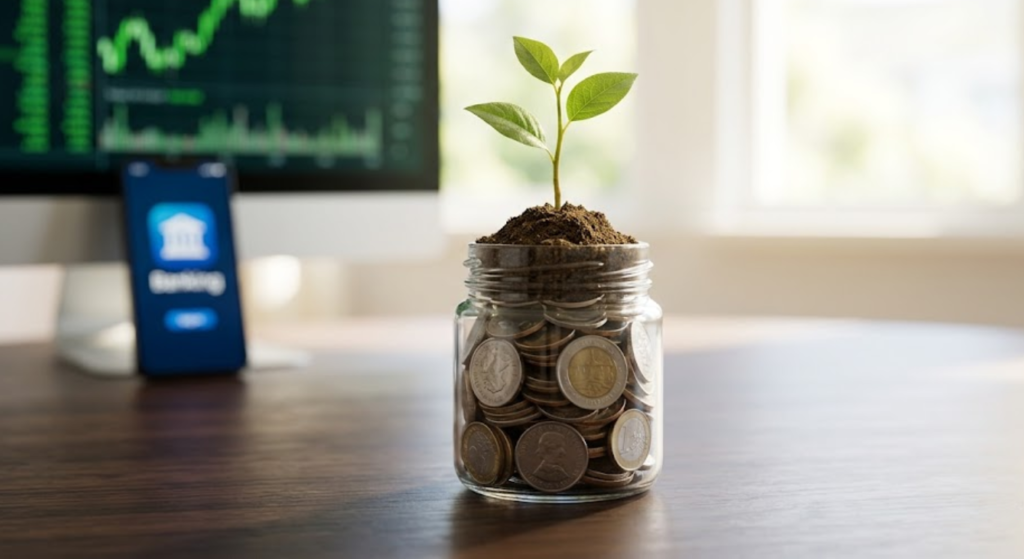
The best time to plant a tree was twenty years ago. The second-best time is now.
Disclaimer: This article is for educational and informational purposes only and does not constitute financial or investment advice. Investing involves risk, including the possible loss of principal. Always consult a qualified financial advisor before making investment decisions. Past performance is not indicative of future results.